
Here’s a theory: you think chest tightness is just stress—true or lazy myth? Bronchospasm hits like a belt yanked around your ribs. You sip air, not gulp it. Every breath squeaks. Throat crowds. Skin prickles. Panic barges in—loud, wrong, bossy. You cough, it burns, and the mucus doubles down. Fun, right? Not stress. Not drama. It’s airflow blocked. Want to spot it fast, stop it faster, and keep control?
Key Takeaways
- Sudden chest tightness, like a belt cinching or a fist pressing behind the sternum.
- Breathing feels like sipping air through a straw, with short, shallow, effortful breaths.
- Audible wheeze on exhale and squeaky inhale, sometimes with a hypersensitive, irritating cough.
- Throat crowding, metallic taste, skin prickling, and rising panic as air feels scarce.
- Thick, sticky mucus and airway burning add obstruction and fatigue, sometimes visible as airway wall thickening on imaging.
The Sensation: Chest Tightness, Wheeze, and Air Hunger

Although you swear you’re fine, your chest says otherwise—it cinches like a belt you didn’t agree to wear. Air turns stingy. You sip, not breathe. Your ribs play a tight drum. Every inhale squeaks—cheap harmonica, bad timing, zero mercy. You hear the wheeze and think, seriously, that’s me? Yes. It’s you. Pressure stacks. Thoughts race. Calm down? Cute advice. Your throat feels crowded, your tongue tastes metal, your skin prickles like static. You want big gulps, you get crumbs. Sensory vocabulary fails, so you reach for metaphorical comparisons: a fist in your sternum, a lock on your lungs, a room shrinking mid-sentence. You pause, then push. Short pulls. Shorter still. You negotiate with air like it owes you money. It does. Pay up, now.
Why It Happens: What’s Going On in the Airways
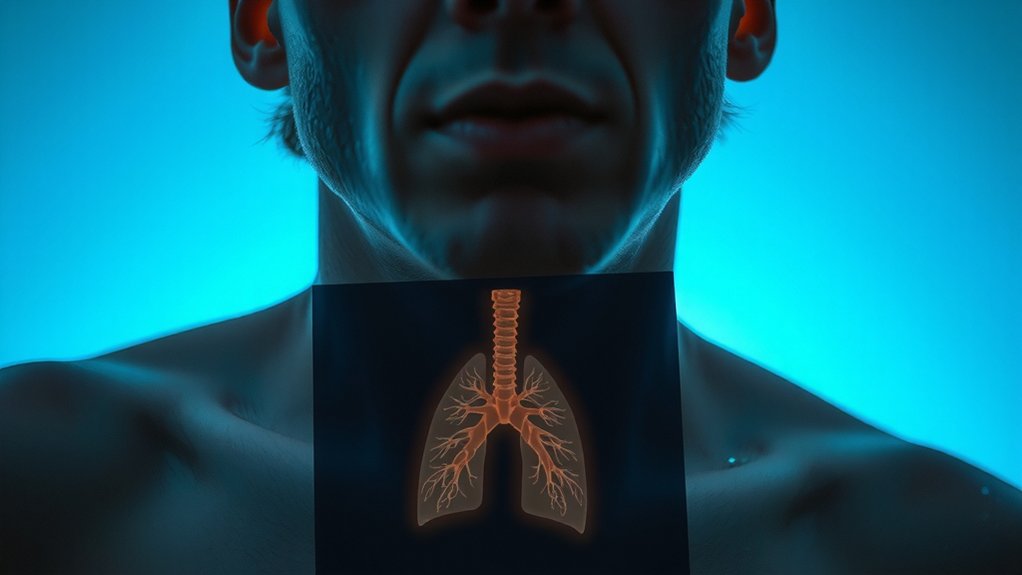
Your airways clamp down as smooth muscle grips tight, like a fist around a straw—feel brave now? Then the lining swells and burns because inflammation crashes the party, shrinking the tunnel you’re begging air to use. And mucus piles on—thick, sticky, stubborn—plugging the route like wet cement, so you push, you gasp, you fight, and yes, you want it gone yesterday.
Smooth Muscle Constriction
Because your airways are ringed with muscle, they can clamp down fast—like a fist around a straw. You feel it, hard and sudden. The smooth muscle squeezes, the tube narrows, and air traffic stops. Why? Nerves fire. Triggers hit. Cold air, strong fumes, a sprint, even laughter—bang, the reflex kicks. You gasp. Your chest argues back.
Don’t blame bad luck alone. Genetic Factors prime those muscles to overreact. Aging Effects stiffen the pipes and slow the “relax” signal. Great combo, right? You breathe; the walls decide no.
You try to push harder. The muscle just pushes back. Stubborn. Territorial. It thinks it’s protecting you. It isn’t. So you plan. Warmups. Fewer irritants. Quick relief ready. You take control before the clamp takes you. Today.
Airway Inflammation and Swelling
Muscle isn’t the only thug choking the tube. Your airway lining swells. It reddens. It hurts. Blood vessels leak fluid into the wall, and the passage narrows like a clenched fist. Nerves scream. You cough, you wheeze, you panic. Why? Triggers slap your immune system. It overreacts. Cells rush in. They release chemicals that light a bonfire under your skin—yes, inside your airway. Heat. Pressure. Tightness.
You want proof not poetry? Fine. Look here.
| What’s happening | What you notice |
|---|---|
| Vessel leak and edema | Swelling, hoarse voice, shallow breaths |
| Cell influx and irritation | Hypersensitive cough, sharp twinges |
| Chemical mediators surging | Burning, tight chest, jittery urgency |
| Wall thickening | Airflow drop, noisy exhale, fatigue |
Diagnostic imaging shows thickened walls; immune profiling names culprits. Proven. Visible. Measurable. Now.
Excess Mucus Plugging
While the walls swell and nerves howl, the airway throws up another barrier—mucus, and lots of it. You feel it instantly. Not dramatic enough? Fine. It’s glue. It grabs air and holds it hostage. You cough hard, nothing moves. Then a clump shifts, and it burns. Your sputum characteristics turn weird—thick, stringy, maybe yellow, sometimes brown, like a bad joke you have to swallow. Why so much? Ciliary dysfunction. The tiny brushes meant to sweep crud out just fail, and you pay. Plugs form. Airflow slams into a dead end. Panic spikes. You push, you wheeze, you bargain. More coughing. Less oxygen. Great plan, right? You need movement now. Hydrate. Heat. Huff. Don’t wait. Because plugs don’t care; they sit and suffocate you slowly.
Common Triggers You Might Encounter

Face it—you’ve got repeat offenders stalking your airways: allergens and irritants; exercise and cold air. Dust and smoke and perfume then a sprint in icy wind—boom your chest clamps like a vise because of course it does. Think you can outrun it or breathe it off—really—or will you own the triggers now and hit back today?
Allergens and Irritants
Why does your chest ambush you after a whiff of perfume or a lazy dust cloud under the couch? Because your airways throw a tantrum. Pollen, pet dander, mold, smoke, cleaning sprays, that vanilla candle—yep, tiny bullies. They barge in, your bronchial muscles clamp, and breath turns stingy. You cough. You wheeze. You panic. And then you blame yourself. Don’t. Blame the triggers. Companies brag about “fresh” scents while hiding irritants in fine print. Regulatory frameworks try, but loopholes party. So you need armor: sharp labels, ruthless decluttering, sealed storage, masks for chores, and hard no’s to smug aerosols. Consumer education isn’t boring; it’s oxygen. Track patterns. Test environments. Shut windows when neighbors burn. Demand transparency. Guard your lungs. Now. Do it without apology.
Exercise and Cold Air
Perfume isn’t the only punk—your own workout can light the fuse, and cold air hands it matches. You sprint. Your chest locks like a car door in winter. Air slices. You cough. You wheeze. Big shock? Nope. Dry cold strips moisture and your bronchi clamp down like bouncers. You push harder anyway. Brave? Or reckless. Warm up longer. Breathe through your nose. Don’t gift the freeze direct access. Use mask technology that warms air. Simple, not soft. Track your storm with wearable sensors—heart rate spikes, pace dips, that jagged breathing curve you keep ignoring. See it. Believe it. Adjust. Shorten intervals. Swap hills for flats. Or take it inside when wind howls like a siren. You want lungs, not fireworks. Save your breath today.
How It Differs From Anxiety or Other Breathing Issues
Although both make you gasp and panic, bronchospasm isn’t “just nerves”—it’s your airways clamping shut like a vise. You hear a hiss, feel tight bands, and wheeze that squeals. Anxiety? That’s fast breathing with open pipes. You can slow a panic. You can’t sweet-talk a swollen bronchus. It fights back, hard. Chest feels armored. Breath won’t leave, won’t enter. Numbers prove it: peak flow drops, spirometry tanks, oxygen dips. That’s objective testing, not vibes. Then the kicker. Albuterol hits, doors open. That’s medication response. Panic doesn’t do that. Hyperventilation blows off CO2; you get tingling, lightheaded, and a huge yawn. Bronchospasm gives air hunger with effort, muscles straining, neck working overtime. You look scared because you are. And no, it’s not in your head.
What People Say Helps in the Moment

How do you survive the squeeze? You fight smart. You grab your rescue inhaler, shake it like it owes you, and use a spacer if you’ve got one. Two puffs. Slow. You sit forward. Elbows on knees. Shoulders loose. Jaw unclenched. You breathe in through your nose, then push out through pursed lips like you’re cooling soup. Not heroic. Effective.
Kill the chaos. Ditch the trigger, the smoke, the perfume, the cold blast. Fan in your face. Warm drink in small sips. Cough once, sharp, to clear gunk. Count four in, six out. Again. You keep your thoughts on rhythm not panic. Body follows.
And yes, you time it. You wait a minute, reassess, repeat the plan. Because control beats drama. Every. Single. Time.
When to Seek Urgent Care
When do you stop pretending you’ve got this and hit the big red button? When breath feels like sandpaper. When your chest locks up. When words shrink to single syllables. Don’t argue. Check severity indicators, not pride. If rescue meds do nothing within your response timeframe—minutes, not hours—you move. Now. Blue lips? Stridor? Can’t walk ten steps? Enough.
| Sign | What it means | Action |
|---|---|---|
| Silent chest | Airflow near zero | Call 911 |
| Blue lips | Oxygen crash | Call 911 |
| Rescue fails | No relief in 15 min | ER now |
| Confusion | Brain starving | ER now |
Still hesitating? Ask your gut. It’s screaming. Grab ID, meds, phone. Go. Better a false alarm than a final one. You want proof? Try breathing through a straw. That’s your clue. Get help now.
Tips to Reduce Future Episodes
You made the call and lived to gripe about it. Good. Now do the boring stuff that actually saves your lungs. Track triggers. Smoke? Perfume? Cold air? Be ruthless. Use a spacer. Warm up before workouts. Hydrate. Sleep like it’s medicine.
Medication adherence isn’t cute, it’s survival. Take controllers daily, not just when you wheeze. Set alarms. Tape notes to the fridge. Refill before you’re out. Carry your rescue inhaler everywhere, not somewhere.
Check your Vaccination schedule. Flu, COVID, pneumococcal. Germs love drama. Don’t give them a stage.
Clean filters. Wash bedding hot. Declutter dust traps. Pets off the pillow, yes I said it. Plan for flare weather. Have an action plan. Share it. Practice it. Breathe on purpose. Repeat. Start today. No excuses.